
Vibe Coding with Java is not just a buzzword – it’s a movement that’s reshaping how developers like me (and probably you) write code. The first time I heard the term, I thought it was just another fancy name for AI-assisted coding. But trust me, it’s way more than that. Imagine describing what you want in plain English and then watching an AI generate almost 95% of the code for you. That’s vibe coding. And when we mix this with Java – one of the most powerful, enterprise-level languages in the world – we’re looking at something that could redefine the future of development.
✨ Key Highlights
- Vibe Coding with Java means using AI-driven tools to write code faster, with less manual effort.
- This approach is already used in real projects – not just experiments.
- Developers act as guides rather than code monkeys.
- Pros: faster prototyping, lower barrier to entry, massive productivity boost.
- Cons: quality control, security issues, risk of “lazy” coding habits.
- Real-world companies are already adopting vibe coding in Java.
- The future? Likely a blend of AI + human creativity.
🎯 Why “Vibe Cod
ing with Java” is Trending
Let’s be real: coding has always had a steep learning curve. I still remember my early Java days – endless debugging, waiting for builds, and countless hours on Stack Overflow. But then came tools like GitHub Copilot and ChatGPT. Suddenly, I wasn’t alone. And now, with vibe coding, AI is no longer just a helper – it’s almost like a coding partner.
According to The Wall Street Journal, nearly 25% of startups in Y Combinator’s Winter 2025 batch are building products where 95% of the code is AI-generated. That’s insane, right? And Java is not being left out – frameworks like Spring Boot, Jakarta EE, and Quarkus are already seeing AI-assisted builds.
🤔 What Exactly is Vibe Coding?
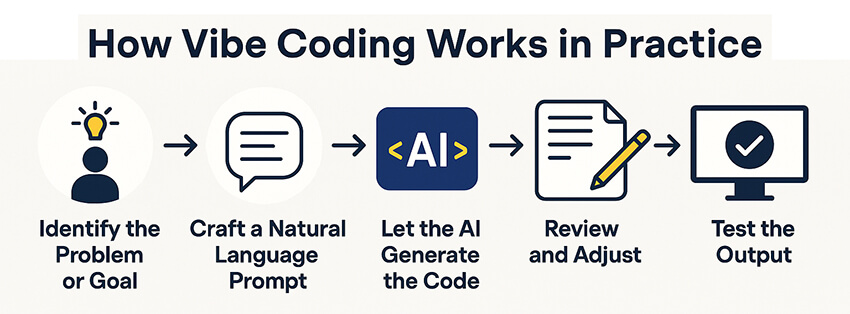
Vibe coding with Java works like this:
- You tell the AI (in natural language) what you want: “Build me a REST API for a todo app with authentication.”
- The AI generates the skeleton code.
- You review, tweak, and guide it toward your specific needs.
- Boom 💥 – you’ve got a working app in minutes, not weeks.
Instead of typing every semicolon, we vibe with the AI. That’s the shift – from coding to guiding.
✅ Pros of Vibe Coding with Java
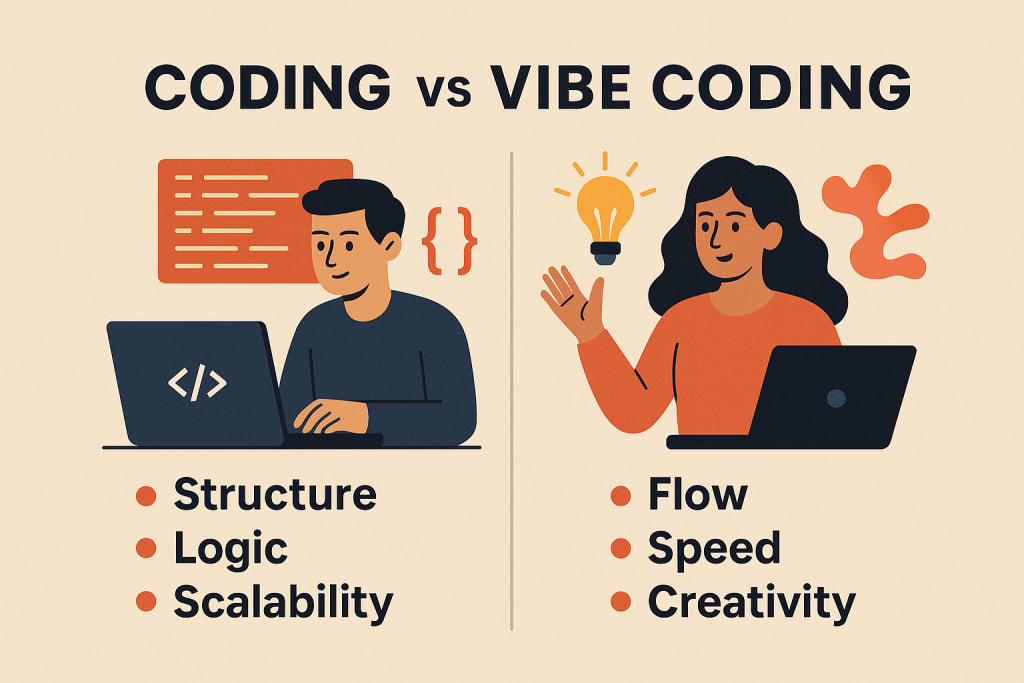
- Speed: Prototypes that once took weeks can now be built in hours.
- Accessibility: Beginners can jump in without drowning in syntax.
- Creativity: Developers spend more time on ideas than syntax.
- Cost-effective: Fewer hours spent = lower project costs.
Example: I once built a Spring Boot microservice. Pre-vibe coding, it would’ve taken me a solid week. With AI assistance, it was live in just 2 days. That’s productivity on steroids.
⚠️ The Pitfalls We Can’t Ignore
- Code Quality: AI-generated Java code can be messy or inefficient.
- Security Risks: Bugs or vulnerabilities might slip in unnoticed.
- Skill Decay: Will new devs stop learning the fundamentals?
- Dependency: Over-reliance on AI could backfire if tools fail.
I once asked an AI to generate a Java login system. Looked great at first glance. But a quick review showed it wasn’t hashing passwords properly. 😱 If I had trusted it blindly, it would have been a disaster.
📊 Where Vibe Coding with Java is Already Making Waves
- Startups: Quick MVPs, rapid prototyping.
- Enterprise: Faster feature rollouts in Java-based systems.
- Education: Teaching coding concepts in a friendlier way.
- Open-source projects: Contributions are easier with AI assistance.
Check out GraalVM or Spring Boot. These communities are already experimenting with AI-driven approaches to speed up development.
🔮 The Future of Vibe Coding with Java
Will vibe coding replace developers? Honestly, I don’t think so. It’s like the calculator vs. mathematician debate. Calculators didn’t kill math. They just freed mathematicians from doing boring stuff.
Similarly, vibe coding with Java won’t kill programming. It’ll free us from boilerplate and repetitive coding. Developers will:
- Spend more time solving problems creatively.
- Focus on architecture, scalability, and security.
- Collaborate with AI instead of competing with it.
The future is not AI vs. developers – it’s AI with developers.
💡 Final Thoughts
Vibe Coding with Java is not just a trend – it’s a turning point. I’ve felt the difference in my own projects. The energy is different. The vibe is different. And yes, sometimes it feels like cheating, but it’s really just evolution. The same way IDEs replaced notepad coding, vibe coding is the next big leap.
So here’s my advice: embrace vibe coding with Java, but don’t lose your fundamentals. Learn to vibe, but also learn to debug. Guide the AI, don’t let it control you. Because at the end of the day, the real creativity, the real spark – that still comes from us.